
The profile did its part. The business did not finish the job.
Yelp leads for contractors need a repeatable inquiry and follow-up process, not just a better-looking page. For a small construction company, that process should be simple enough to run between site visits and clear enough for somebody else to cover.
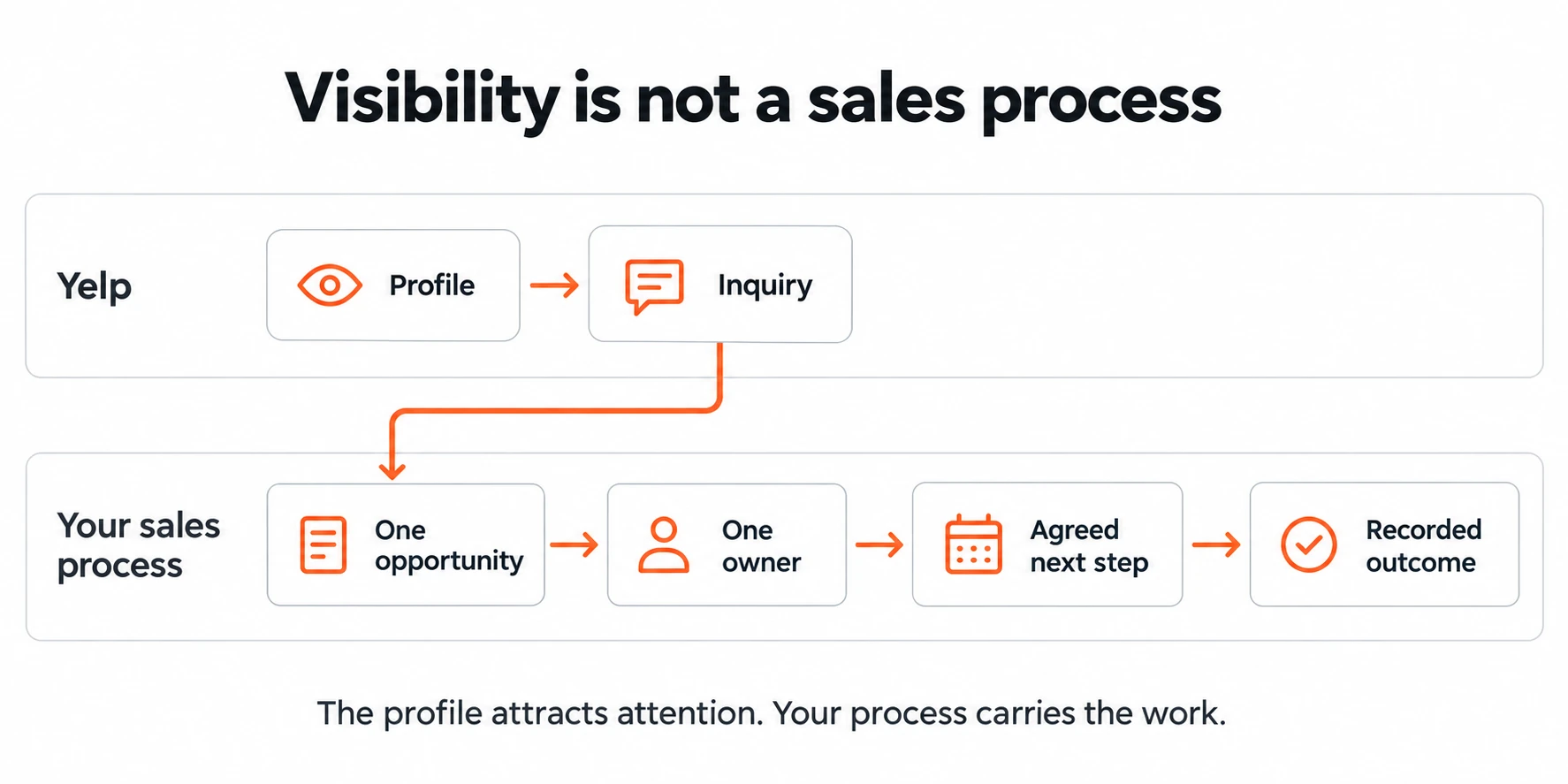
Separate visibility from the sales process
Yelp says claiming a business page is free and does not mean the business is an advertiser. Treat the page, any paid advertising and your internal sales workflow as different things. A claimed listing is not an ad campaign, and a page view is not a customer inquiry. Yelp's claimed-business guidance.
This distinction matters when you review results. If you ran ads, record that spend. If a customer arrived through the listing without evidence of ad involvement, do not automatically attribute the inquiry to the campaign. Keep uncertain source details uncertain.
Buying visibility cannot repair an unanswered inbox.
Make the profile accurate before making it impressive
Describe the work your team can actually deliver. Show relevant project photographs only when you have the right to use them. Keep business contact details, service information and availability statements current.
For a small remodeling company, a clear explanation of the jobs it accepts is more useful than a broad promise to handle every kind of construction.
Check the next step from a customer's perspective. Can someone tell whether you handle their project? Does your page direct them toward a contact method your team monitors? Are any response or scheduling promises realistic?
Do not copy a competitor's claims about licenses, experience or outcomes. Those are facts to verify, not decorative copy.
Understand the quote-request context
Yelp's messaging and Request a Quote options depend on business category and whether the feature is enabled. A customer may be able to send a request to additional businesses for competing quotes. Check the features actually available to your listing rather than assuming every contractor has the same setup. Yelp's messaging and quote-request explanation.
Your response therefore needs to establish relevance, not just announce that you saw the message.
Answer what the customer asked. Then request the information needed for the next decision: work type, location, timing and any scope details that affect whether a visit makes sense.
Do not confuse a request for a quote with a complete scope of work. A customer describing "a small bathroom update" may mean cosmetic changes or a much larger renovation. Qualify the project before committing estimating time.
Build one inquiry record outside the inbox
The conversation can remain in Yelp. The sales record should connect it to your wider business.
For each inquiry, capture:
- Customer and project details provided by the customer.
- Yelp source and the original thread or reference.
- Requested scope, location and preferred timing.
- The person responsible for responding.
- Qualification status and the reason if the project is unsuitable.
- Agreed next step, due date and latest update.
- Proposal reference and final outcome, when available.
If the customer moves to a phone call, link that call to the same record. Do not create a new opportunity every time the channel changes.
A small team can begin with a controlled register. As the history and relationships become harder to manage, a properly structured construction CRM is usually more practical. Either way, someone must own the record.
Use a follow-up sequence that respects the customer
A useful sequence is acknowledgement, qualification, agreed assessment, proposal and a decision follow-up. Each step should depend on what happened at the previous one.
For an illustrative kitchen inquiry, the first response might confirm that the project is within your service area and ask whether the customer has plans or wants help defining the scope. The next action might be a call, not an immediate site visit.
After a visit, record the missing information before promising a proposal date. When the proposal is sent, confirm how the customer wants to discuss it and when a follow-up would be useful.
Set your own coverage targets based on staffing and working hours. There is no universal response-time number that makes every construction business successful.
Stop chasing when the customer declines, asks you to stop or no longer has a suitable project. Persistent follow-up and repeated unwanted messages are not the same thing.
Keep reviews separate from sales follow-up
Yelp explicitly tells businesses not to ask for Yelp reviews. Do not import a review-request automation from another platform, offer incentives or ask friends to improve the listing's rating. Yelp's review guidance.
You can still improve the customer experience that precedes a review: clear expectations, reliable updates and honest handling of issues. When responding to public feedback, keep private project details out of the reply.
A sales follow-up asks whether a customer needs help making a project decision. A review request asks for public feedback. Keep those workflows distinct.
Review outcomes rather than profile activity alone
A weekly review should show inquiries received, suitable opportunities, appointments completed, proposals sent and resolved outcomes. Include open opportunities with overdue next actions. Keep these measures distinct in your construction sales dashboard.
For paid activity, keep channel spend and confirmed attribution visible. Compare acquisition cost with the contribution expected from won work, not only its headline contract value.
Do not divide this week's wins by this week's inquiries if those wins came from older projects. Use comparable periods or inquiry cohorts, and show unresolved cases separately.
Look at loss reasons before declaring that Yelp does or does not work. If suitable inquiries repeatedly stall after the site visit, the issue may be proposal ownership. If most are outside your services, the profile or targeting deserves attention.
One large job also does not establish a dependable pattern. Review enough completed opportunities to understand your own sales cycle and the variation between project types.
Make the handoff part of the promise
When a customer accepts, transfer the agreed scope, proposal version, contact preferences and commitments to the delivery team. Otherwise, the next project manager inherits a customer who thinks the business already knows everything.
That gap is one of the ways construction companies lose customers before the job starts. Fixing it is process work, not another profile refresh.
Blackwing helps construction businesses connect lead sources to practical sales records, follow-up and delivery handoffs. If inquiries are arriving but nobody can explain what happens to them, book an operations review.
FAQ
Do contractors need Yelp Ads to claim a business page?
No. Yelp says claiming a business page is free and does not make the business an advertiser. Paid advertising is a separate decision. Review the current product terms before committing spend and keep paid results separate from other inquiries.
Can every contractor use Yelp Request a Quote?
No. Yelp says messaging and quote-request options depend on business category and whether the feature is enabled. Check your own listing and inbox settings. Do not design an intake process around a feature your account does not have.
How should a small contractor follow up with Yelp leads?
Assign an owner, record the project details, agree the next step and set a due date. Link later calls and proposals to the original inquiry. Follow up according to the customer's preferences and stop when further contact is unwanted or unhelpful.
Should contractors ask customers for Yelp reviews?
Yelp's guidance says businesses should not ask for Yelp reviews. Avoid review-request campaigns and incentives. Focus on the customer experience, accurate profile information and respectful responses to feedback instead.