
That is an expensive way to run a sales process.
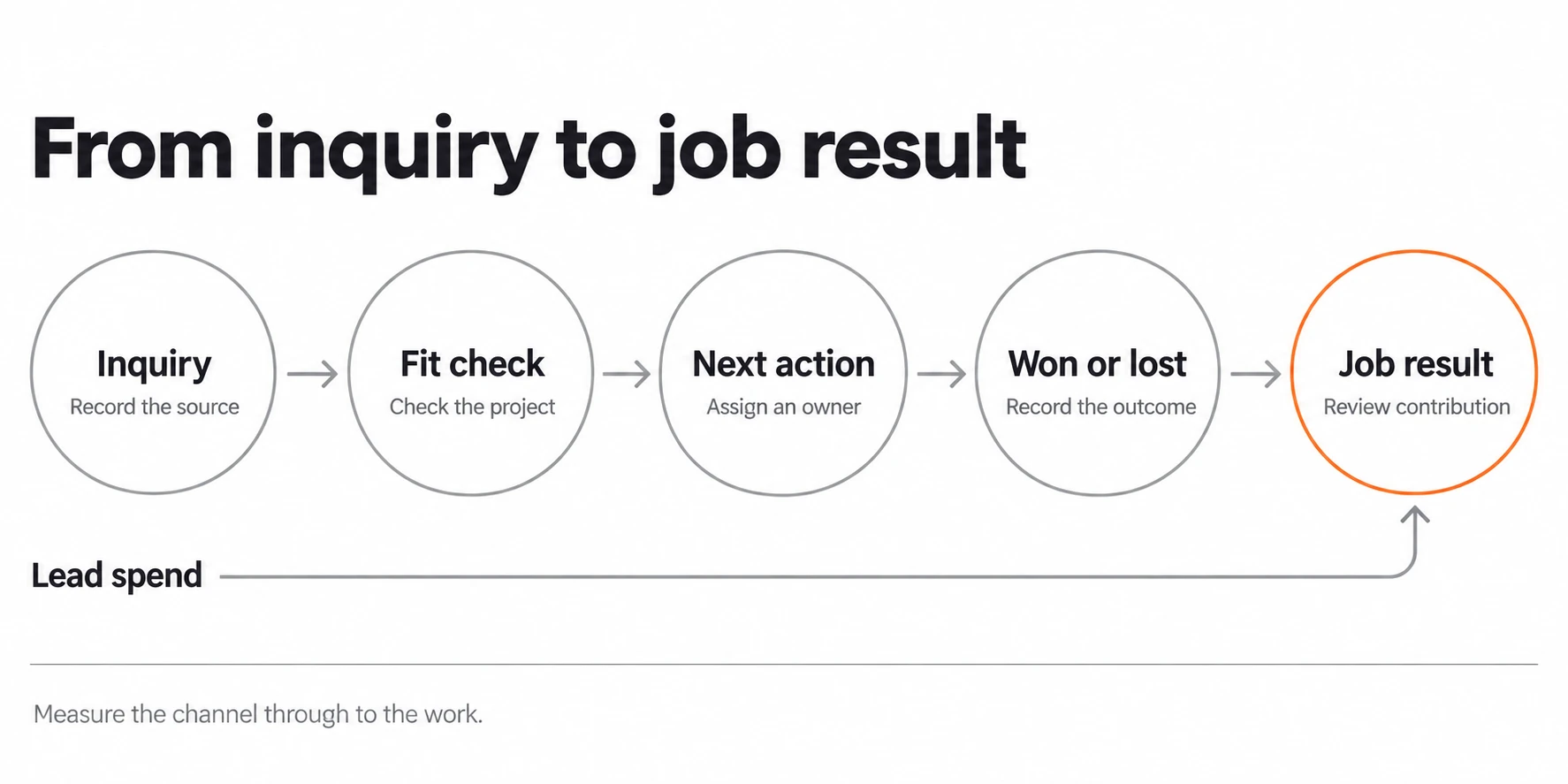
Thumbtack leads for contractors need a workflow that connects each inquiry to its cost, owner, next action and eventual job result. More notifications are useful only when you can turn the right inquiries into work your business can deliver profitably.
What are you actually buying on Thumbtack?
Thumbtack says joining does not require a subscription or membership fee, and pros control lead pricing and budgets. Its contractor-facing explanation describes paying when a new customer contacts or hires you. That is different from paying only after you win and complete a job. Check the current settings and charging terms in your own account before committing spend. Thumbtack for pros, how jobs work.
The operational consequence is straightforward: an inquiry may carry a cost before you have qualified the project. A customer contacting you is not the same as a customer choosing your proposal.
Do not build a budget around a universal price-per-lead estimate from somebody else's market. Use the prices, services and rules actually shown to your business.
Start with the work you want to accept
A small contractor cannot be equally good at responding to every possible project. Define the work you want before broadening your lead flow.
Write down your service area, project types, practical scheduling capacity and the work you do not take. If you use a minimum project value, make sure your team can explain it without presenting an early estimate as a binding quote.
For example, a remodeling company might accept occupied-home bathroom renovations within its normal travel area but decline emergency repairs. That is an illustrative business choice, not a rule every remodeler should copy.
Align the profile and available targeting settings with those choices. A profile that promises everything gives your team a qualification problem it could have avoided.
Give every inquiry one owner and one next action
The platform inbox can hold the conversation. Your business still needs a record that survives a busy day or an employee's absence.
Capture these fields in your construction CRM or a controlled lead register:
- Inquiry ID, date received and original platform conversation link.
- Contact details supplied by the customer and project location.
- Requested work, timing and relevant fit questions.
- Lead charge or spend reference, when applicable.
- Assigned owner, current status and most recent customer update.
- Next action and due date.
- Final outcome and an honest reason when the opportunity closes.
Keep the original inquiry even if the same customer later calls. Link the additional contact to the existing opportunity rather than counting a second lead.
An automation can help create records, but test duplicates, missing details and failed deliveries before trusting it. A notification is not proof that the CRM was updated.
Respond with a useful next step
Set a response expectation that matches your coverage. If the owner is also on site all day, pretending the business has a dedicated sales desk will not fix anything.
A useful first response answers the customer's actual question, checks a small number of fit details and proposes the next step. For a remodel, that might mean confirming the type of work, approximate location and whether the customer is ready for a site assessment.
Do not send a twelve-question form before acknowledging the request. Do not promise a final price from two photos if the scope needs an inspection.
When a visit or call is agreed, record who owns it and what information must come back. After a proposal goes out, agree a follow-up date instead of leaving the opportunity in a permanent state called "quote sent."
Measure the channel after the sales cycle has had time to finish
The question is not simply how many leads Thumbtack produced. It is what those leads became. A useful construction sales dashboard connects the channel to resolved outcomes without hiding open opportunities.
Review a cohort: a defined group of inquiries received during the same period. Allow enough time for your normal sales cycle before judging its results. Show open opportunities separately from wins and losses.
Useful measures include:
- Paid inquiries and total platform spend for the cohort.
- Qualified opportunities and reasons for poor fit.
- Site assessments or estimating appointments completed.
- Proposals issued and jobs actually won.
- Cost per won job: attributable channel spend divided by won jobs in that cohort.
- Estimated job contribution, with the costing basis stated.
If no jobs have been won, cost per won job is unavailable, not zero. If most opportunities are still open, say the cohort is immature.
Consider a fictional example: $600 of lead spend generates three won projects. Channel spend per won job is $200. That number still does not tell you whether the channel is attractive. You need the expected contribution from those projects, the estimating effort and the work your team declined elsewhere to accommodate them.
Revenue is not profit. A busy calendar is not proof of a good acquisition channel.
Diagnose the loss before increasing the budget
A low win rate can have several causes: poor project fit, delayed responses, weak qualification, estimating capacity, pricing or the customer's changed plans. Do not label every loss "bad lead" because it is convenient.
Use a short, consistent list of reasons. Keep "no response" separate from "price declined" unless the customer actually told you price was the issue.
Then review a sample of the underlying conversations. If most inquiries are outside your services, revisit fit settings. If suitable customers wait days for a next step, fix ownership and coverage. If proposals stall, check whether anyone agreed a decision date.
Increase spend only when the process and the economics support the decision. There is no prize for buying more leads than your team can handle properly.
Build the system around the channel
Thumbtack can be one source of work. It should not become the only place your sales history lives.
Connect it to your wider construction sales process, with clear qualification, estimating and delivery handoffs. Use a bid or no-bid decision when an opportunity would consume time your team cannot recover.
Blackwing helps construction businesses design those workflows and implement the records, ownership and follow-up around them. The platform supplies the inquiry. Your system determines what happens next.
If paid leads are arriving but their outcomes remain unclear, book an operations review to map the journey from first contact to a won, deliverable job.
FAQ
Is Thumbtack free for contractors?
Thumbtack describes joining as free, without a subscription or membership fee, but leads can carry charges. Review your account's current lead prices, budget controls and charging terms. A free profile does not mean every customer inquiry is free.
How should a contractor track Thumbtack leads?
Use one record per project opportunity, linked to the customer and original platform inquiry. Record source, cost, owner, fit, status, latest update, next action and final outcome. Merge duplicate contacts without deleting the original history.
What is the best metric for Thumbtack lead performance?
There is no single sufficient metric. Review qualified opportunities, won jobs, cost per won job and job contribution for a consistent inquiry cohort. Keep unresolved opportunities visible so recent leads are not prematurely judged as failures.
Should I buy more leads if my team is busy?
Check response, estimating and delivery capacity first. Additional lead spend can create wasted inquiries if nobody can follow up or deliver the work. Expand only when suitable demand, operating capacity and measured economics support it.