
A future project can be worthwhile without being ready for an estimate today. The business needs a place for it, a reason to revisit it and a clear stop condition. Otherwise the CRM becomes a storage unit for optimism.
Distinguish not ready from not suitable
Not suitable means the work does not fit the company’s services or agreed requirements. Not ready means a potentially suitable project depends on a future decision, document or timing condition. No response means you do not yet know. Those are three different situations.
Do not use “nurture” to avoid recording a loss. If the customer chose another contractor, record that outcome. A possible future relationship can be handled separately without keeping the lost opportunity open.
Agree a reason to reconnect
| Readiness condition | A useful next action | Avoid |
|---|---|---|
| Design is being developed | Ask whether a check after the design review would help | Pretending a detailed quote is already due |
| Funding decision pending | Agree whether and when the customer wants to reconnect | Assuming funding or giving financial advice |
| Customer timing is later | Record the requested review window | Promising a future crew slot without approval |
| Scope is undecided | Offer the appropriate scoping conversation | Sending irrelevant sales reminders |
| Customer requests no follow-up | Stop the outreach and apply the relevant record policy | Moving the contact to another sequence |
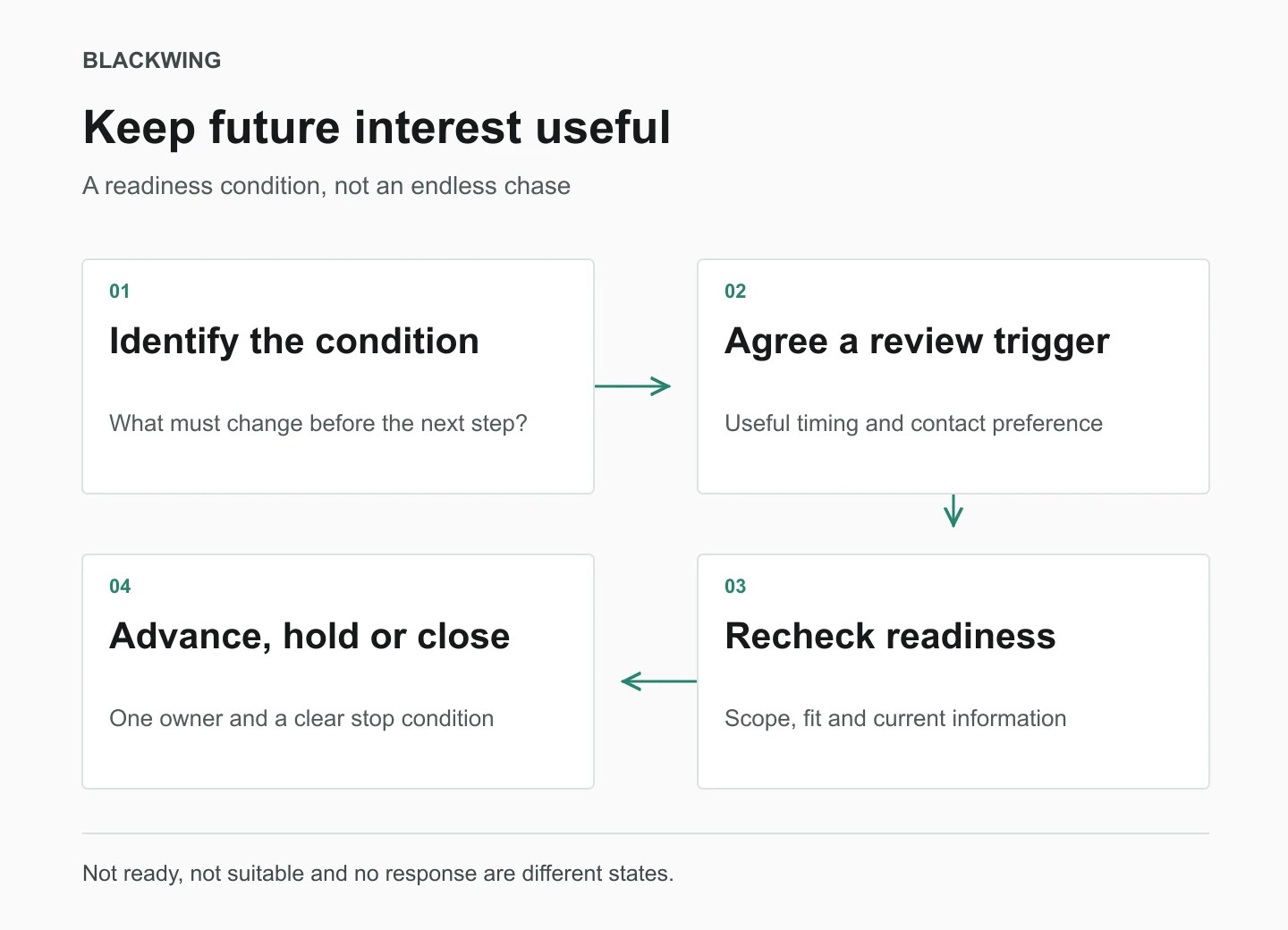
A useful question is: “Would you like us to reconnect after that decision, and what would make the next conversation helpful?” Keep the answer and the preferred contact route. A date can be provisional; the reason for the date should not be missing.
Use a separate future-review state
Give the record a readiness reason, review trigger, owner, next review date and last confirmed customer preference. Keep it outside the near-term award forecast unless there is evidence that the expected decision belongs in that period.
The contact, past inquiry and future opportunity should remain connected without being collapsed into one timeless deal. When the project changes materially, preserve the earlier discussion and create or revise the relevant inquiry according to your record rules.
Start with the construction CRM structure and keep the distinction from estimate follow-up. Estimate follow-up concerns an issued offer; future-project nurturing concerns readiness for a later sales step.
Send something that helps the next decision
The message should relate to the known condition. If the customer is preparing for a scoping meeting, a short list of useful documents may help. If they are waiting for a design decision, an agreed check after that meeting may be enough. Not every contact needs a newsletter.
Avoid implying that the customer must decide immediately to retain a price or slot unless that statement is true, authorized and clearly explained. Do not invent scarcity to make a dormant opportunity look more active.
An illustrative follow-up that respects timing
“When we last spoke, you were waiting for the revised layout before choosing the next step. You suggested reconnecting this month. Is that still useful, or would you prefer us to leave it with you? If the layout is ready, we can confirm what information our estimator would need.”
The message gives context and an easy way to pause. It does not pretend the sender has monitored the project or imply that a price is reserved. If the customer asks not to be contacted, stop. Keep any required suppression record through the approved privacy process.
Keep automation modest
- Use a reminder for the owner before an external sequence.
- Pause when a reply, complaint or changed preference needs review.
- Stop when the project is closed, unsuitable or no longer wanted.
- Recheck old scope, timing and contact details before advancing the record.
- Keep failure and suppression handling visible to the team.
A future review can be event-based rather than weekly. If nothing useful can happen before a funding or design decision, repeated internal checks add little. The right cadence follows the customer’s agreed readiness condition, not the automation platform’s default schedule.
Review the quality of the future-project list
Check how many records have a meaningful readiness reason, current permission and a next review. Track reactivated qualified opportunities separately from messages sent or records touched. A large dormant database is not proof of future revenue.
Periodically review whether the information is still necessary to retain and whether the relationship remains appropriate for follow-up. Apply the company’s privacy and retention rules. This guide does not establish legal permission to contact someone.
When the readiness condition is met, return to lead qualification and then the first-meeting workflow. Blackwing helps design those transitions so future interest has a useful place without distorting the active pipeline.
Blackwing helps small construction teams connect their sales process, records and operating systems. Start with the handoff that is failing, then agree the owner, information and exception route before automating it.
Questions contractors ask
What is construction lead nurturing?
Construction lead nurturing maintains an appropriate, permitted relationship with a potentially suitable customer whose project is not ready for the next sales step. It uses a known readiness condition, agreed review trigger and useful information rather than indefinite generic follow-up.
Should not-ready projects remain in the active sales forecast?
Not automatically. Keep a future-review state distinct from near-term expected awards. Include a project in a forecast only when the evidence and period fit the company’s stated rules. Interest in a future project is not a confirmed construction commitment.
When should a contractor stop nurturing a lead?
Stop when the customer asks, the project is unsuitable or closed, the contact basis is no longer appropriate, or the agreed terminal condition is met. Review unanswered records under a defined policy rather than moving them into another endless sequence.